LinkedIn profile optimization for founders who want clients
The checklist we run on every founder profile, from the one sentence that says what you do to the two Featured items a buyer clicks.

Founder of Blen12 min read
On this page
A founder's LinkedIn profile is optimized when a buyer who lands on it can tell what you do in about 3 seconds, sees proof they believe, and knows the one thing to do next. Fix the top of the profile first (photo, cover image, headline), then carry the same message through About, Featured and Experience.
This is the checklist we run when we rewrite a client's profile, section by section, with the templates we write from.
The checklist at a glance#
| Section | Its job | The check |
|---|---|---|
| Offer sentence | Say what you do and for whom | A stranger can repeat it after one read |
| One action | Tell a buyer what to do next | Every section asks for the same thing |
| Photo | Show a real person worth talking to | Your face, good light, at least 400 by 400 pixels |
| Cover image | Put your offer and proof in one glance | A one-line tagline, a row of real logos, nothing hidden behind your photo |
| Headline | Say who you are and what you offer wherever your name appears | Role and company, offer, a number, a call to action, 150 characters or fewer |
| About | Turn curiosity into belief | One skeleton, results in digits, ends on the one action |
| Featured | Give the click somewhere to go | Book a call and your best proof sit first and second |
| Experience | Back it up with outcomes | 1 to 3 lines of results in your current role |
A founder profile does a different job#
Most profile advice is written for people looking for a job. It tells you to fill the page with keywords for recruiter search, list every skill and summarise your career.
Your reader is a buyer. They reach your profile because you sent an invite, messaged them or they saw one of your posts, and they decide in seconds whether you're worth a reply. So the profile has to answer what you do, why they should believe you and what they should do now, in that order and fast.
Write one sentence that says what you do#
Before you touch a single section, write the sentence the whole profile hangs on. Ours always takes this shape.
Helping [exact who] [get the exact thing they want].
Specific wins every time. "Helping family-owned manufacturers sell their company" beats "M&A advisory services", and "Helping dental groups hire associates in 30 days" beats "healthcare recruitment". Words like solutions, growth, innovation and transformation give a stranger nothing to picture, so cut them.
That sentence then shows up in three places.
- The second block of your headline is this sentence, or a tight cut of it.
- Your cover image tagline is this sentence in 10 words or fewer.
- Your About opens with it, in "I" or "we" form.
If you can't write it crisply, don't start on the headline yet, because every section drafted without it comes out vague. Read it to someone outside your industry. If they can't say back who you help and with what, keep going.
Build your proof list at the same time#
Write down every concrete number, client you're allowed to name, well-known company you've worked with, press mention, credential and before-and-after you have. Rank them by how much your buyer would care, and spend that list across the headline, cover image, About and Experience.
A section with no proof in it is unfinished. A modest true number still beats an impressive invented one, so if the list is thin, use what's real.
Pick the one action every section points at#
A profile that asks for five things gets none of them. Decide what a buyer should do next, then make the cover image, headline, About, Featured and Experience all ask for that same thing.
For most founders that action is a message. If you have a booking link, it can be booking a call through Featured. If you're hiring founders or investing, it might be applying through Featured.
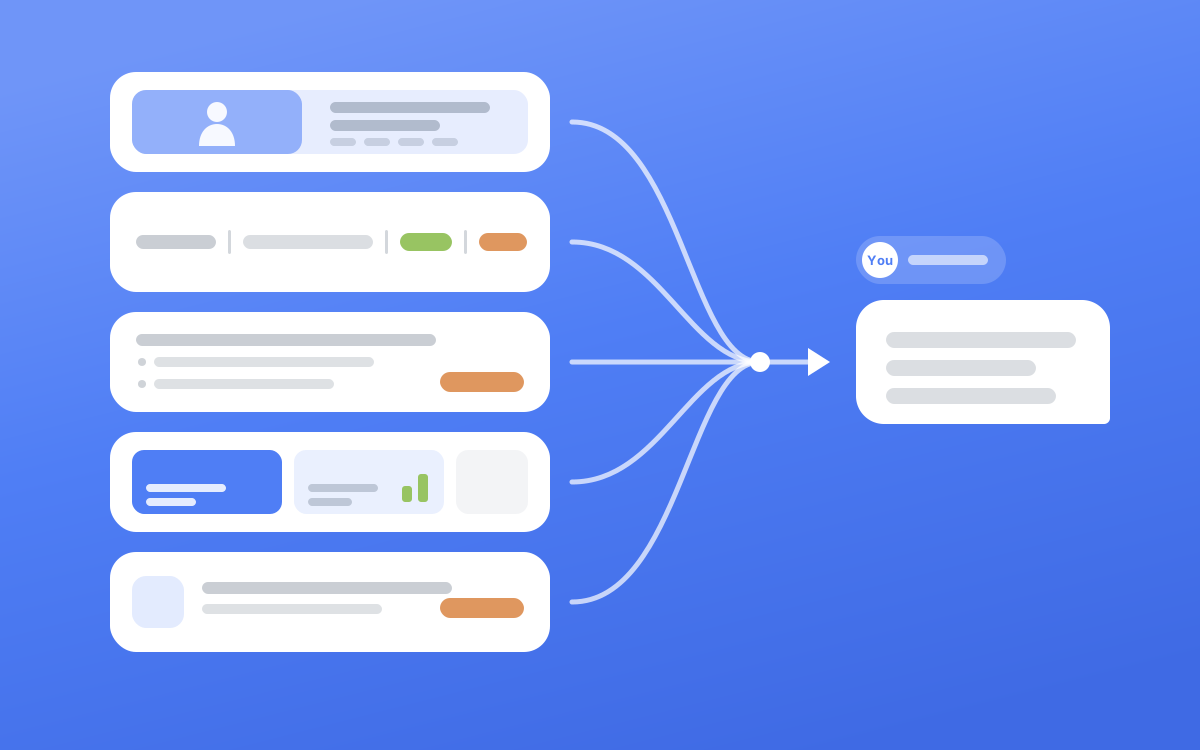
We often end on a question about their problem, such as "send me a message and tell me what you're trying to fix", because for a stranger that's a smaller step than booking a 30-minute call.
Photo#
LinkedIn reported in 2016 (opens in a new tab) that members with a profile photo got 21x more profile views and up to 36x more messages. It's an old number from a job-search context, and it's still the cheapest fix on this list.
- Use your face. LinkedIn's Professional Community Policies (opens in a new tab) say not to use "any other image that is not your likeness" for your profile photo, so your company logo belongs somewhere else.
- Face the camera in good light, recent, alone in the frame, with your head and shoulders filling most of it.
- Upload a PNG or JPG of at least 400 by 400 pixels and under 8MB, per LinkedIn Help (opens in a new tab).
We ask clients for four kinds of photo, a clear headshot, one of you working, one speaking or on stage and one with other people. The last three are what the cover image and posts get built from.
Cover image#
LinkedIn now calls the banner your cover image. The recommended size is 1584 by 396 pixels, and in its note on blurry uploads LinkedIn's help page (opens in a new tab) adds that "Photos will also look better than images with logos."
Every client cover image we design follows the same simple formula.
- A tagline that is your offer sentence in 10 words or fewer, written as one plain line. A clever line needs a second read, and nobody gives it one.
- A row of real logos from clients, partners or press you're allowed to show, 5 at most, all in one colour with even gaps. Logos read faster than a stat row like "20 years, 500 projects" and borrow credibility a number can't. Never type a brand name out in place of its logo.
- Your company logo above the tagline.
- A real photo filling the other half, of you speaking, your team, your product or your venue. Never an AI image pretending to be you or your office.
A written call to action on the cover image is optional. We leave it off by default and add one only when a client's profile needs it.
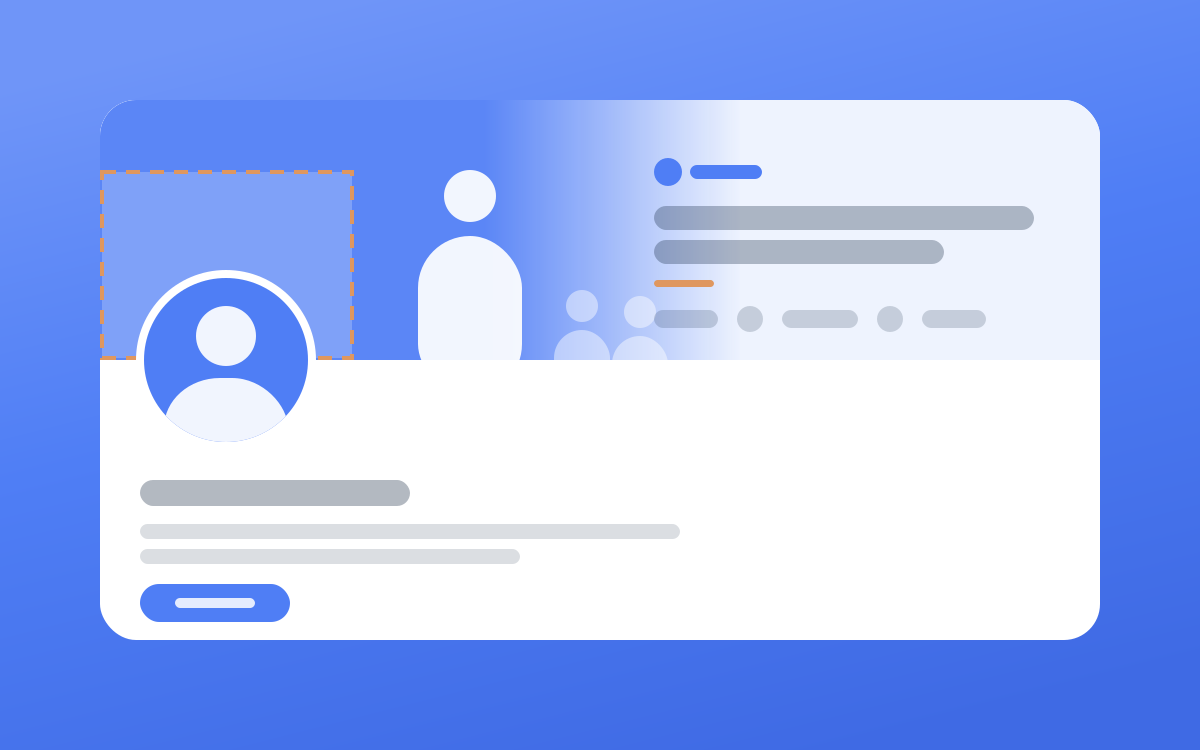
Your profile photo sits over the bottom-left corner, so on a 1584 by 396 canvas we keep roughly the bottom-left 400 by 300 pixels free of text and logos (a photo can run under it). The text goes on the right half. Phones trim the sides, so look at the upload on your own phone before you call it done.
Headline#
This is the one section people see without visiting you, next to your name in invites, comments and search. Every headline we write follows one shape.
[Role] of [Company] | [Your offer sentence] | [A proof number] | [Call to action]
- Open with your role and company. In our own drafts, headlines that led with a clever "Helping you..." phrase lost to the plain role-first version every time a client picked.
- Put your offer sentence in block two.
- Include at least one number.
- End with a call to action. "Message me to learn more" is our default, and "Apply from Featured section" works when the action is an application.
- Stay at 150 characters or fewer, separators included. LinkedIn lets you write more, but a long headline reads as a wall and gets cut off anyway. To trim, drop a second proof block first, then shorten the offer, and keep the opener and the call to action.
Two made-up examples in that shape.
- Founder of [Company] | Helping Dental Groups Hire Associates in 30 Days | 140+ Clinics Staffed | Message Me to Learn More
- Managing Partner, [Firm] | Helping Family-Owned Manufacturers Sell Their Company | 25 Exits Advised | Message Me
For more formulas by type of founder, and the mistakes we see most, read our LinkedIn headline guide for founders.
About section#
Write in first person. Use "we" when you front a company and the company is what people buy, and "I" when you are the brand, like an advisor or a coach.
Only the opening lines show before "see more", so line one is your offer sentence and has to work on its own.
The skeleton most founders pick#
We call it results-led, and it runs about 90 words. Clients choose it more than any other because it goes from what you do to proof to action in the fewest lines.
[What we do, in one plain line.]

Results:

- [A win that starts with a number]
- [A win that starts with a number]
- [A win that starts with a number]
- [A win that starts with a number]

If you're a [exact buyer] looking for:

- [What they want, in their words]
- [What they want, in their words]
- [What they want, in their words]

Send me a message and tell me [the problem you solve].
A made-up example of it filled in.
We help dental groups hire associate dentists in 30 days.

Results:

- 140+ clinics staffed across the UK
- 30 days average time to hire
- 400+ associates placed since 2019
- 3 of the 10 largest UK dental groups as clients

If you run a dental group and you're looking for:

- Associates who stay past their first year
- A shortlist within a week
- One recruiting partner for every clinic

Send me a message and tell me which roles are open.
Other skeletons, and when they fit#
Pick one and follow it start to finish. Blending two in one About reads like two people wrote it.
| Skeleton | Use it when | How it runs |
|---|---|---|
| Results-led | You have 4 or more solid numbers | Offer line, results, who it's for, one action |
| Journey-led | You have a real origin moment and hard numbers to land after it | The moment, your mission, the problem you saw, results since, where you are today, one action |
| Credibility-first | Your headline numbers are big enough to speak alone | One big summary line, your mission, what you help with, results, one action |
| Credentials-led | Your strongest proof is institutional (government work, enterprise clients, years, offices) | Offer line with your years attached, a long list of checkable facts, who it's for, a call to action that asks for their problem |
What to leave out#
- An opening that narrates the reader's worries back at them ("You're thinking about selling your company again..."). We retired that structure because it reads like a late-night advert.
- Links. Put them in Featured, where they support the one action.
- Superlatives like expert, world-class or visionary. Give the facts and let the reader decide.
- Walls of text. Put a blank line between every block and keep one idea per line.
Featured section#
According to LinkedIn Help (opens in a new tab), you can feature your posts, articles, links to outside websites and uploaded media, and reorder them once you have at least two. Only the first cards show before the row scrolls, so we lock the two that matter at the front.
This is the order we use for clients.
- Book a call, with your booking link. This is the item the whole profile points at.
- Case studies or results, your strongest proof, sitting right next to the ask so a buyer sees proof beside the button.
- Your personal or company website.
- A lead magnet, like a template, checklist or guide that solves one pain your buyer would name.
- A second lead magnet in a different format, or for a different pain.
- Up to 3 items that fit you, such as a 60 to 90 second intro video to camera, a podcast or press feature, a newsletter signup, your best post, or a community or event you run.
Those last items should be real ones only. If slots 4 and 5 are empty, that's your brief for what to build next.
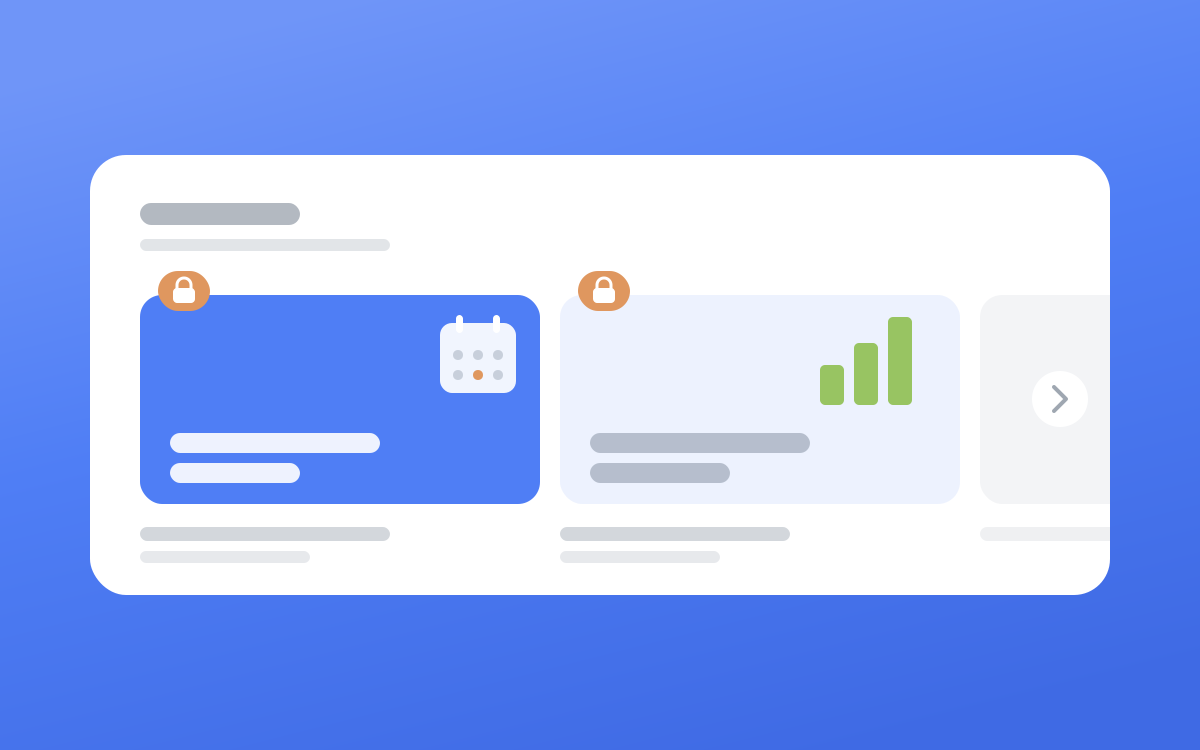
We design each tile at 1200 by 627 pixels with the action in big type in the bottom-left ("Book a call with [Company]") and your logo. The words on the tile ask for the same thing as the rest of the profile.
Experience#
Rewrite your current role in 1 to 3 lines about outcomes, with a blank line between each. Two sentences about what happened do more than a list of duties.
A made-up example.
Grew from 2 clinics to 140 across the UK in 4 years.
Now placing 60 associate dentists a quarter.
Send me a message if you have roles open.
End on the same action as everywhere else when it fits naturally.
Skills and the rest of the profile#
Skills matter most for search. LinkedIn's same 2016 post (opens in a new tab) said members with 5 or more skills were contacted "up to 33x more by recruiters and other LinkedIn members". Add 5 that match what you sell, then spend the rest of your time on the top of the profile, where buyers make up their minds.
Write it from a conversation, then test it#
Don't polish your old profile line by line. We never read a client's current profile before writing, because the old copy anchors the new one.
Write from how you talk instead. We write from a recorded interview with the client and pull their real phrases out of the transcript. On your own, record yourself explaining your business to a friend for 10 minutes and write from what you actually said.
Then test it. Show the top of your profile to someone outside your industry for 3 seconds and ask them what you do, who it's for and what they'd do next. If any answer is wrong, fix the offer sentence before anything else.
Check the whole profile every quarter, and rewrite it whenever your offer or your buyer changes.
What turns a profile visit into a reply#
Most visits come right after something you did, like an invite, a message or a post. The message they got and the profile they land on have to say the same thing, with the same offer, the same buyer and the same next step. If your first message after they accept talks about one problem and your headline talks about another, the visit ends there. Our guide to the first message after someone accepts covers that half.
Posts do the slower work of making a stranger believe you before they ever click, which is what a LinkedIn content strategy for founders is for.
This is why we finish a client's profile before a single invite goes out. At Blen the order is always the profile rewrite and redesign first, then the lead list, then outreach. The full sequence is in how to get clients on LinkedIn.
Frequently asked questions#
Should a founder's About section be in first or third person?#
First person. Third person reads like a press bio someone else wrote, and the buyer is deciding whether to message you as a person. Use "we" when your company is what people buy and "I" when you are the brand.
How long should a founder's LinkedIn About section be?#
As long as the skeleton you picked needs. Our results-led About runs about 90 words, and a journey-led one with a real origin story runs much longer. Either way, only the opening lines show before "see more", so the first line has to carry your offer alone.
Should my LinkedIn profile promote me or my company?#
Your personal profile is the one that sends invites and messages, so it should say what your company does for buyers, fronted by you. Keep your role and company at the start of the headline, and let the About and Featured carry the company's proof.
Can I use my company logo as my profile photo?#
No. LinkedIn's Professional Community Policies ask members not to use an image that isn't their likeness as a profile photo. Put the logo on your cover image and Featured tiles instead.
How often should I update my LinkedIn profile?#
Review it every quarter and rewrite it whenever your offer or buyer changes. Swap new proof in as soon as you have it, like a bigger client or a better number, since proof is what the profile runs on.